
The facade of a building serves as its public face, an architectural canvas that communicates the essence of its design, purpose, and character. Beyond being a mere exterior shell, a building’s facade plays a pivotal role in shaping its identity and influencing the urban landscape. In this article, we delve into the definition, key characteristics, and various types of building facades that shape our architectural landscape.
Building Facade Definition
A building facade refers to the exterior face or front elevation of a building. It is the part of a structure that is visible from the outside and serves as a key element in defining the building’s architectural character and style. The facade plays a crucial role in the overall design, aesthetics, and functionality of a building.
Features of Facade Systems
While the characteristics of facade systems vary based on the wall materials employed, they share common attributes. Facade systems exhibit resilience to water and moisture, although the level of durability depends on the specific product chosen. Notably, the water and moisture resistance of metal facade systems differs from that of styrofoam materials.
Facade systems possess protective qualities against both external elements and interior spaces, shielding against radiation and UV rays. Essentially, the application of coatings on a building’s exterior contributes to its overall well-being.
The coated exteriors also demonstrate mechanical strength, effectively withstanding wind-induced shaking, pressure, and abrasion. The material used for coating on exterior walls plays a pivotal role in determining the effectiveness of this feature.
Every building facade system offers diverse design possibilities to customers. With design options limited only by human imagination, selecting suitable facade systems for any building becomes a relatively straightforward task.
Among the various materials, metal stands out as the one that optimally leverages the shared features of facade systems. Particularly, expanded metals prove highly advantageous for walling systems.
Facade systems possess protective qualities against both external elements and interior spaces, shielding against radiation and UV rays. Essentially, the application of coatings on a building’s exterior contributes to its overall well-being.
The coated exteriors also demonstrate mechanical strength, effectively withstanding wind-induced shaking, pressure, and abrasion. The material used for coating on exterior walls plays a pivotal role in determining the effectiveness of this feature.
Every building facade system offers diverse design possibilities to customers. With design options limited only by human imagination, selecting suitable facade systems for any building becomes a relatively straightforward task.
Among the various materials, metal stands out as the one that optimally leverages the shared features of facade systems. Particularly, expanded metals prove highly advantageous for walling systems.
What Are the Different Types of Facades?
1.Lightweight Facades

This facade variant adheres to the building’s robust structure without forming an integral part of it. Since it doesn’t contribute to the building’s stability, the lightweight facade necessitates a design that can bear the loads exerted on its components.
Typical cladding materials for this type of facade include glass and metal.
Two construction methods are prevalent for lightweight facades: curtain wall and panel facade. In a curtain wall, the facade seamlessly encircles the structure’s framework, while in a paneled facade, the framework interrupts the facade.
Noteworthy advantages of the lightweight facade system include its straightforward installation process and its ability to admit ample natural light into the building.
In comparison to other facade types, lightweight facades offer lower levels of heat and sound insulation, accompanied by higher maintenance costs in the medium and long term.
This facade category is predominantly employed in medium and high-rise office buildings.
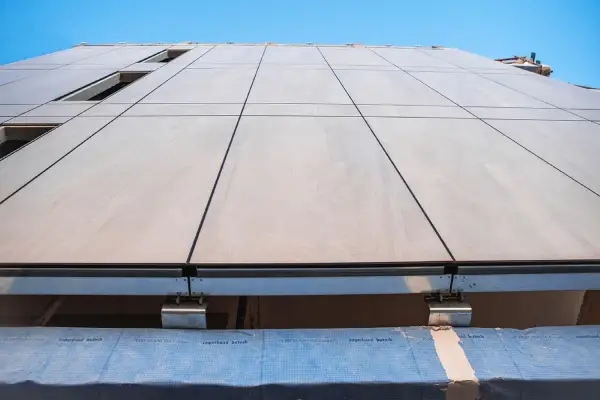
Comprising predominantly prefabricated modules either joined together or assembled at the construction site, this facade type relies on components manufactured in highly mechanized plants, commonly employing materials like wood and concrete panels.
2.Heavyweight Façades
As the name suggests, this category of facades is typically constructed using materials of substantial weight. To qualify as a heavyweight facade, the total weight, encompassing both solid and hollow elements, must surpass 100kg per square meter.
Within this classification, various facade types exist, each tailored to specific thermal insulation requirements. These facades may be load-bearing or self-supporting, and their design may include or exclude an air chamber based on insulation needs.
3.Prefabricated Façades
Comprising predominantly prefabricated modules either joined together or assembled at the construction site, this facade type relies on components manufactured in highly mechanized plants, commonly employing materials like wood and concrete panels.
Key advantages of this facade category include rapid and straightforward installation processes, along with cost-effectiveness when compared to alternative systems. However, limitations in design options and a prerequisite minimum volume of work pose notable disadvantages.
Typically applied in industrial factories and expansive shopping centers, prefabricated facades find practical use in large-scale construction projects.
4.Traditional Façades
This category encompasses facades constructed with traditional building materials like brick, stone, wood, ceramics, rendering, and similar elements.
The advantages lie in their simplicity of construction, rapid installation, and cost-effectiveness.
Conversely, classic facades lack an air chamber or insulation, resulting in reduced thermal and acoustic insulation. This, in turn, translates to diminished energy savings.
Advantages of Metal in Building Facade

Metals exhibit numerous advantages over alternative materials in facade systems, consistently securing a pivotal role in building exteriors.
The metal facade coating process involves affixing flat or patterned panels, typically crafted from materials like aluminum or steel, onto the outer walls. This panel-based system allows for targeted modifications, requiring the removal of only the affected portion. Compared to other materials, metal imparts a contemporary aesthetic to a building’s exterior.
Metal facade systems deliver enduring protection to structures, boasting longevity without the need for frequent maintenance intervals.
These systems seamlessly integrate with other facade counterparts, such as glass, presenting building owners with an extensive array of design possibilities. The adaptability of metal facades is instrumental in selecting the most suitable system for a building, offering diverse combinations.
An inherent advantage of metal facade systems lies in their cleaning and maintenance ease. Unlike other facade types that may necessitate painting and modification for cleaning, metal elements can be easily maintained with just water and a cloth. The process is not only straightforward but also cost-effective.
In the realm of natural disasters like earthquakes, the lightweight nature of metal facade systems plays a critical role in preventing loss of life. The protective attributes of metal panels become particularly significant in such circumstances.
Commercial Building Facade Ideas and Examples
These three innovative concepts for commercial building facades exemplify how a seemingly straightforward element can significantly enhance the appeal of commercial real estate investments.
Situated in Miami, One Thousand Museum is a luxurious condominium tower. The sophisticated, steel-blue facade gracefully ascends the building, mirroring the nearby beach ambiance and the glamorous nightlife of Miami. According to Sulichin, “The late Zaha Hadid crafted this luxury condo tower with a facade approach that establishes the building’s tone and accentuates its exotic design.”
Barclay’s Center stands out with its distinctive rusted steel facade, crafted from weathering steel to achieve a leathery brown appearance. This type of steel develops a protective layer of rust, serving as a shield against moisture and halting the corrosion process. Beyond its practical benefits, the weathering steel facade holds aesthetic appeal for many designers and architects.
The Maverick, a 20-story commercial building in Chelsea, showcases ingenuity with its acid-etched precast concrete panels. This example illustrates how architects can creatively utilize basic building materials. The facade design focuses on aesthetics, capturing sunlight at various angles. To add dimension and privacy, punched windows are incorporated into the facade panels.
For additional information on our metal facade designs, feel free to contact us. Allow us to assist you in selecting the optimal facade system for your building, drawing upon our extensive knowledge and experience in the industry.
1.One Thousand Museum in Miami
Situated in Miami, One Thousand Museum is a luxurious condominium tower. The sophisticated, steel-blue facade gracefully ascends the building, mirroring the nearby beach ambiance and the glamorous nightlife of Miami. According to Sulichin, “The late Zaha Hadid crafted this luxury condo tower with a facade approach that establishes the building’s tone and accentuates its exotic design.”
2.Barclay’s Center in Brooklyn
Barclay’s Center stands out with its distinctive rusted steel facade, crafted from weathering steel to achieve a leathery brown appearance. This type of steel develops a protective layer of rust, serving as a shield against moisture and halting the corrosion process. Beyond its practical benefits, the weathering steel facade holds aesthetic appeal for many designers and architects.
3.The Maverick in Chelsea, Manhattan
The Maverick, a 20-story commercial building in Chelsea, showcases ingenuity with its acid-etched precast concrete panels. This example illustrates how architects can creatively utilize basic building materials. The facade design focuses on aesthetics, capturing sunlight at various angles. To add dimension and privacy, punched windows are incorporated into the facade panels.
For additional information on our metal facade designs, feel free to contact us. Allow us to assist you in selecting the optimal facade system for your building, drawing upon our extensive knowledge and experience in the industry.
