
  |
We sometimes receive calls from our customers who want to know what measurements should be provided to select the most suitable mesh pattern for their application. In this article, we will explain how to measure and specify expanded metal mesh for your application.
What is the difference between raised and flattened mesh?
Expanded metal mesh is measured differently depending on whether it is raised or flattened, and both have different measurement terminology.
The original form of expanded metal is always characterized by a raised appearance. This is characteristic of the unique slit and stretch motion employed to manufacture the product. This presents angular strands inclined from the sheet plane.
A raised mesh floor can be characterized by its angular appearance, which not only gives it strong aesthetic appeal, but also offers a number of practical features, such as offering grip underfoot, directing air, liquid and light, and providing a key whenever it is used as a substrate.
It is commonly used for walkway ramps, security fencing, building exteriors and internal walls, and plaster and render laths.
In most cases, expanded metal is treated using a secondary process in which heavy rolls are used to remove the strands. The result is a flattened mesh sheet that is completely two-dimensional with its strands aligned in the same plane as the sheet. When a flush finish is desired, flattened mesh is often recommended.
Flattened mesh is used for a variety of applications, including security partition mesh, conical air filters, and machine guards.
How do I measure raised mesh?
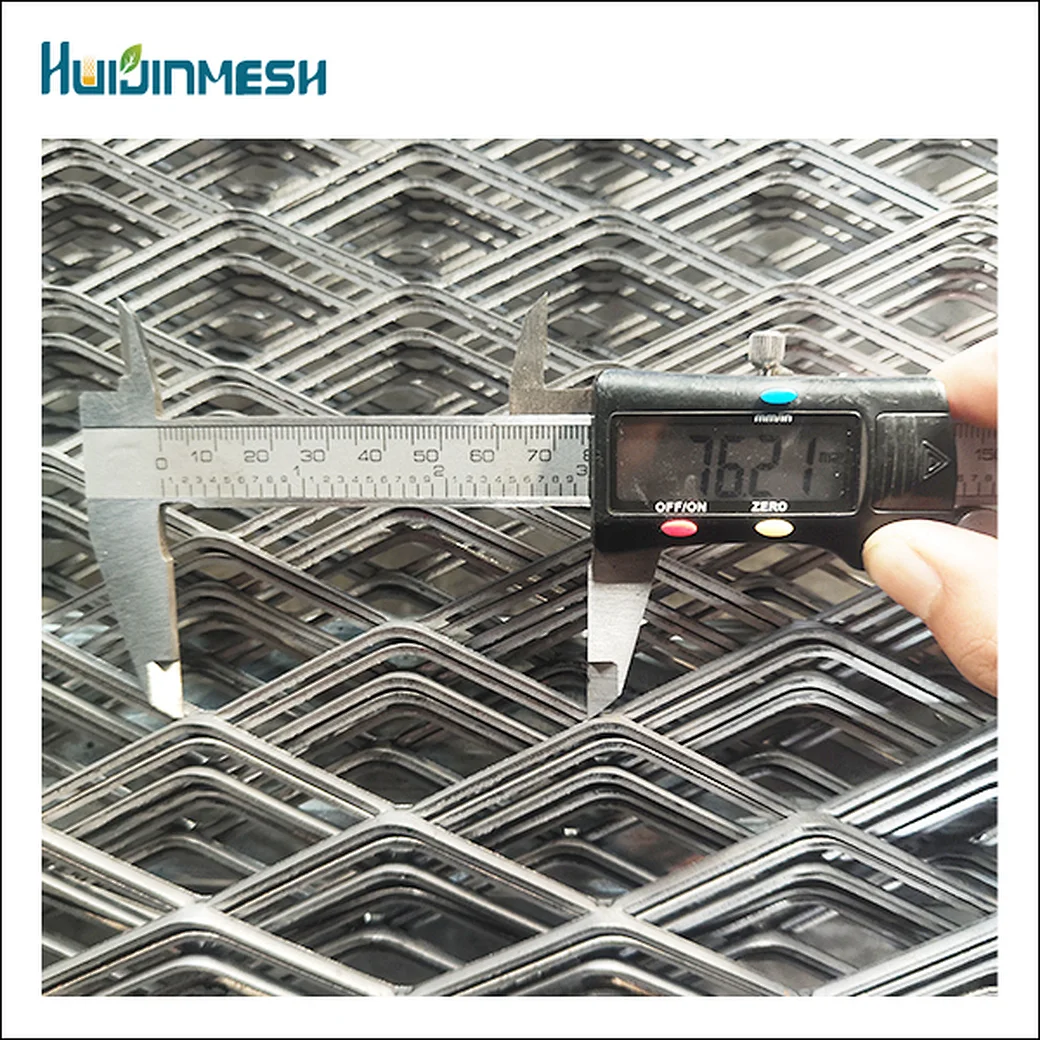
For a raised mesh, there are four key measurements to know: the Longway Pitch (LWP), the Shortway Pitch (SWP), the Strand Width (SWDT), and the Strand Thickness (STK).
An LWP is measured horizontally from knuckle to knuckle or from center to centre based on the size of tooling used during production.
SWP is a measure of manufacturing expansion, measured vertically from knuckle to knuckle or centre to centre.
A SWDT measures the width of an angular strand formed during manufacture.
The STK metric determines the starting thickness of raw materials. Contrary to popular belief, expansion does not directly affect raw materials’ thickness. Stress, on the other hand, is not the same as metal’s overall height or depth. Mesh height is typically 1-2 times taller than SWDT.
How do I measure flattened mesh?
There are several key measurements for a flattened mesh, including Longway Aperture (LWA), Shortway Aperture (SWA), Strand Width (SWDT) and Strand Thickness (STK).
The LWA is measured horizontally from one point of the internal aperture to another point of the internal aperture.
The SWA is measured vertically from point to point inside the aperture.
SWDT is a measurement of the width of the angular strand created during manufacturing.
The STK measurement determines the thickness of raw materials in production.
Although the expanding process does not alter material thickness, the flattening process does. It is common to observe that a material thickness reduction of 10-20% results after flattening from plain to flattening. Vertical mesh height is considered. The starting material thickness with an additional allowance for 10-20% material thickness reduction.
Which size and orientation should I use?
It can be observed that the mechanical and aesthetic properties of expanded metal mesh differ when the sheet size is oriented at opposing angles to the sheet size.
There are several factors to consider when specifying sheet dimensions. This includes the orientation of the diamonds, which is indicated by a Longway Mesh (LWM) or Shortway Mesh (SWM) in relation to the sheet size.
As an example, when raised mesh is used as a walkway ramp platform, the surface grip will be stronger when the diamonds run left to right and underfoot when the diamonds run left-to-right.
Furthermore, an expanded mesh fencing panel with diamonds pointed longways to the sky is commonly used in the security fence industry. This is to create narrower fence openings. This prevents people from climbing up the fence or scaling it.
Contact us if you need more support or want to discuss further.
Expanded Metal Definitions
Bond: The point where adjacent strands intersect. The bond is always twice the width of the strand.
Camber: Bow in sheet. It is measured by placing a straight edge along the concave side of the sheet parallel to LWD, touching both ends of the sheet. The maximum distance between the edge of the expanded metal and the straight edge is the camber. A sheet may be within tolerance and still have camber.
Diamond or Opening: This is the description of the open area formed by strands and bonds. Normally the open area is diamond shaped.
LWD: Long Way of Design – Distance from a point on a bond to a corresponding point on the following bond measured across the Long Way of Design. Also referred to as “pitch LWD”.
LWO: Long Way of Opening – Distance measured from the inside of the bond across to the inside of the bond LWD.
Mesh: This is the nominal distance from the mid-point of one bond to the mid-point of the next bond measured across the SWD. Mesh is expressed in inches.
Opening Size: The area enclosed by bonds and strands.
Overall Thickness: This is the finished thickness and often determines the selection of framing members.
Percent of Open Area: These important relative percentages are used by designers to calculate the degree with which light or air can pass through a piece of expanded metal.
Pitch: The measurement from a point on one diamond to the same point on an adjacent diamond.
Strand: The single metal strip which forms the border of the diamond, or opening. Strand width is the amount of material advanced for expanding as differentiated from strand thickness which is the thickness of metal from which the expanded metal is produced.
- Thickness: Standard Expanded Metal: Gauge or thickness of the sheet or coil from which the expanded metal was produced.Flattened Expanded Metal: Overall thickness of the finished sheet.
- Width: Standard Expanded Metal: Amount of metal fed into the expanding machine, which is slit and stretched with each stroke of the upper die.Flattened Expanded Metal: Width of the strand.
Style: The gauge or thickness of metal from which expanded metal is made. Usually, but not always, this conforms to manufacturer’s standard gauges. Style is expressed by a number. Grating style is expressed in pounds per square foot.
Formability: Each piece should be able to take a 90 degree bend with a 1/4 inch inside radius in either direction, without fracture.
Finishing: Limited finishes can be accomplished at manufacturing plants. This includes hot dip galvanizing and pre-galvanizing.
Leveling: All expanded metal products except grating are leveled after having been expanded.
Out of Square: Expanded metal sheets are generally not perfectly square when finished. Sheets must be re-squared by shearing on all sides for perfect squareness. Reshearing at the mill is not usually done since most sheets are sheared to size by the customer.
SWD: Short Way of Design – Distance from a point on a bond to a corresponding point on the following bond measured across the SWD. Also referred to as “pitch SWD”.
SWO: Short Way of Opening – Distance measured from the inside of the bond across to the inside of the bond SWD.
